The ebook
Music Theory
A structured guide to how music is built and how it is written down — written and published by The musics.name project.
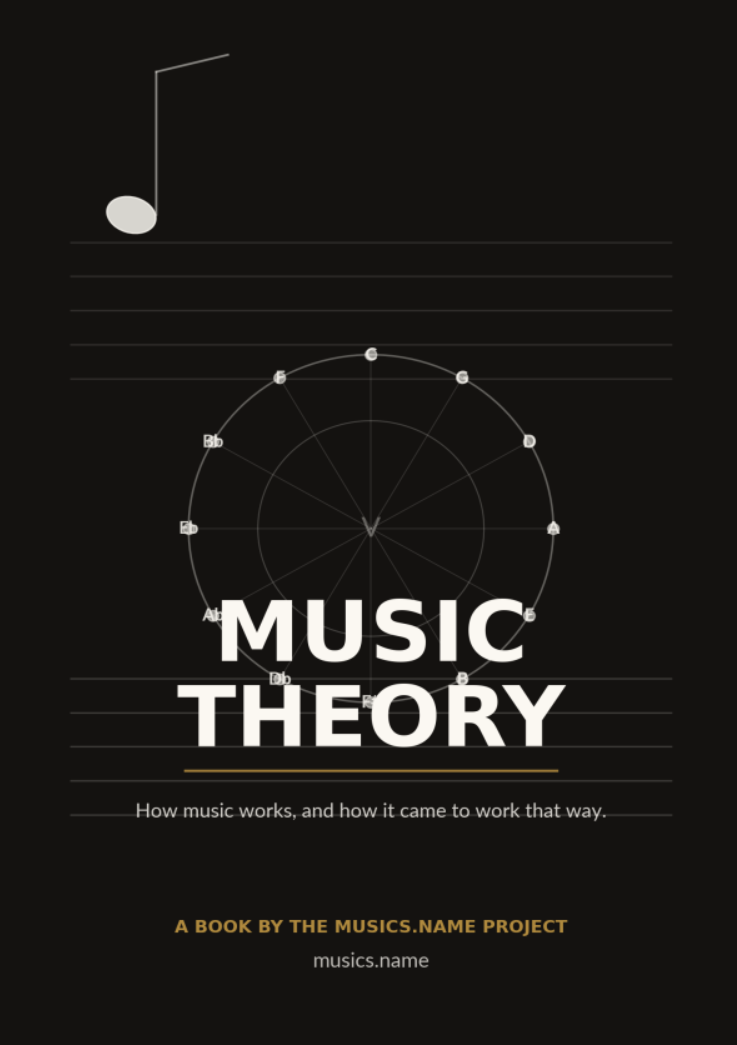
The site's working library as a structured ebook: intervals, keys, harmony, counterpoint, rhythm, form, tuning, orchestration and the history behind them. The material is drawn from this site’s working library — 28 articles on music theory and music history, plus five browser tools you can play. Tables, interval names, key signatures and historical claims follow the published articles.
- 78 pages
- PDF download
- $2.87 only
Sold securely through Gumroad. Instant PDF download after checkout; also kept in your Gumroad library.
What's inside
Nine areas in reading order, each following the articles and tools on this site.
- 01Intervals and notationHow intervals are counted and named, clefs, transposition and octave numbers.Read free
- 02Keys and scalesKey signatures, the order of sharps and flats, and the scales built on them.Read free
- 03Harmony and voice leadingChord function, cadences, seventh chords, mixture and secondary dominants.Read free
- 04Counterpoint and fugueFirst species, imitation, invertible counterpoint and the subject-answer relationship.Read free
- 05Rhythm and meterBeat hierarchy, syncopation, hemiola, hypermeter and polyrhythm.Read free
- 06Form, tuning and historyLarge-scale design, temperament and what it costs, orchestration, and how notation made tonality possible.Read free
Questions
What format is the ebook, and how do I receive it?
A 78-page PDF, delivered as an instant download after checkout. Gumroad also keeps a copy in your library, so you can re-download it any time.
Is this the same material as the free articles?
It is drawn from the same working library — intervals, keys, harmony, counterpoint, rhythm, form, tuning, orchestration and history — but rewritten as one structured book you can read front to back, offline, and keep. The articles stay free on this site.
Who wrote it?
The musics.name project: written, reviewed and published the same way as the articles on this site, with the tables, interval names, key signatures and historical claims following the published pieces.