Word Painting in the Madrigal: Music That Depicts Its Text
Word painting sets a single word to a melodic shape that mirrors its meaning. Late sixteenth-century madrigalists made it central, and critics objected.
On this page
Word painting, also called text painting, sets a single word to a musical shape that reflects its meaning, such as a falling line on a word about death or a rest on a word about silence. Italian and English madrigal composers of the late sixteenth century made the device central to their music, and it came to be called madrigalisms. Critics thought the practice was often too literal, and the argument about its limits runs through the whole period.
Key takeaways
- Word painting ties a melodic or harmonic gesture to the meaning of one word or short phrase.
- It was developed especially in late sixteenth-century Italian and English madrigals, where its devices were called madrigalisms.
- Madrigals are through-composed, so each stanza, line or even single word can receive its own music.
- Critics objected to the literal setting of words. Thomas Campion called the close observing of words childish in 1601, and Giovanni Maria Artusi attacked the harmonic liberties of the moderns in 1600.
What a madrigal was
A madrigal is secular vocal music, most typical of the Renaissance and early Baroque. The polyphonic madrigal is unaccompanied and usually has three to six voices. Most madrigals are through-composed: each stanza gets different music, and the composer follows the emotion of each line and, often, of single words. The name is shared with a fourteenth-century Italian form that differs from it in nearly every other respect.
The Renaissance madrigal grew out of several sources. Madrigals written by Italianised Franco-Flemish composers in the 1520s drew partly on the three- to four-voice frottola, partly on renewed interest in vernacular Italian poetry, and partly on the French chanson and the polyphony of the motet. The frottola set each stanza to the same music, while the madrigal is through-composed, so the difference is in the structure as much as the sound.
Because word painting works word by word, it can be read straight from the page. The text sits under the notes, one syllable at a time.
Setting the word under the note
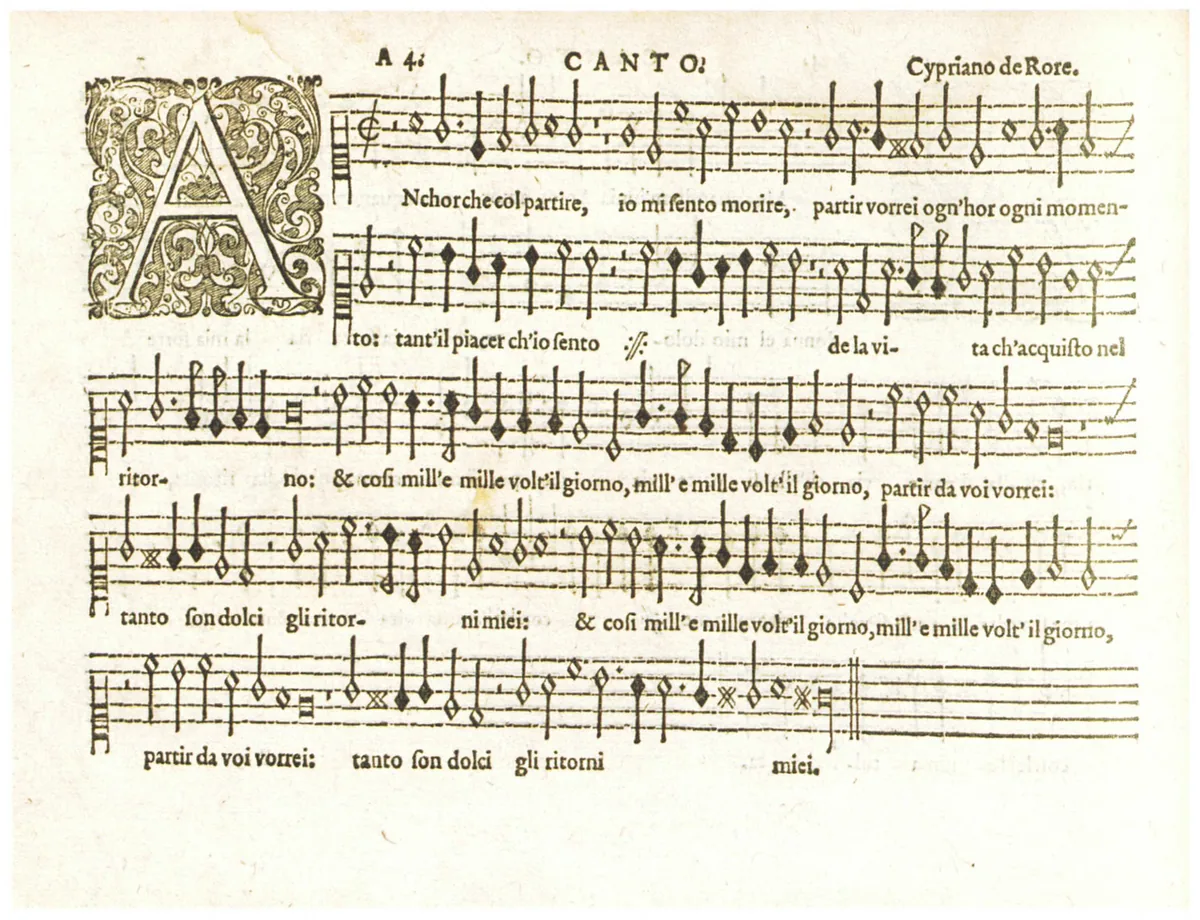
Renaissance printers placed each syllable beneath the note it was sung to, so a reader can see exactly which word receives a long note, a dense run or an unusual interval. Cipriano de Rore’s madrigal Anchor che col partire survives in a printed cantus partbook, marked A 4 for four voices. Its opening words, Anchor che col partire, io mi sento morire (“even at parting, I feel myself dying”, our translation), are printed under the first phrase of the melody.
Reading the text against the notes is the first step in hearing word painting. The connection is written into the page, so you do not have to guess at it.
Some scholars trace the technique back to Gregorian chant, where the shape of a melody was sometimes tied to the meaning of a word. The madrigal made it the organising principle of the whole piece.
Marenzio and the late madrigal
The late madrigal had not always been serious. In the 1560s composers including Marc’Antonio Ingegneri, Monteverdi’s teacher, Andrea Gabrieli and Giovanni Ferretti brought lighter elements back into the genre. The villanella and the canzonetta, with their dance rhythms, replaced some of the serious Petrarchan verse about love, longing and death.
Luca Marenzio (1553–1599) wrote around five hundred madrigals, ranging from the lightest to the most serious, and many are packed with word painting and chromaticism. His lighter madrigals reached England in 1588 in Musica transalpina, the anthology that started the English madrigal craze. Marenzio spent most of his career in Rome, and his output shows how the Italian style could be adapted to very different moods.
Gesualdo and extreme chromaticism
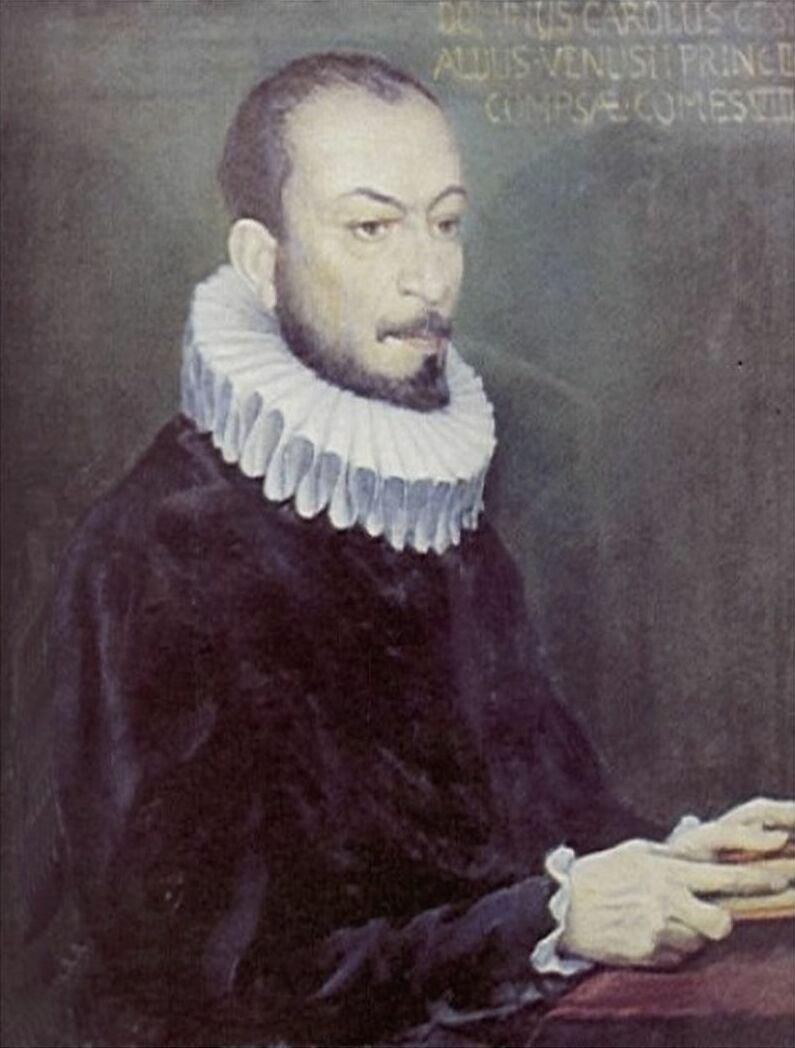
Carlo Gesualdo was born in 1566 into an aristocratic family and wrote madrigals with some of the most extreme chromaticism of his age. In the early 1590s he learned the chromatic style and textural contrasts of the Ferrarese composers, among them Luzzasco Luzzaschi, but few madrigalists followed his extreme chromaticism. Monteverdi later avoided its stylistic extremes and concentrated on the drama of the text instead. Few composers followed Gesualdo that far. Antonio Cifra and Sigismondo d’India used his techniques selectively, and in the 1620s Michelangelo Rossi, whose two books of unaccompanied madrigals show sustained chromaticism, is described as his successor.
Word painting and chromaticism often appear together in these madrigals. A word the composer wants to stress can receive a chromatic note or a remote harmony, so the listener hears the stress as well as the sense.
English madrigals and a manuscript refrain
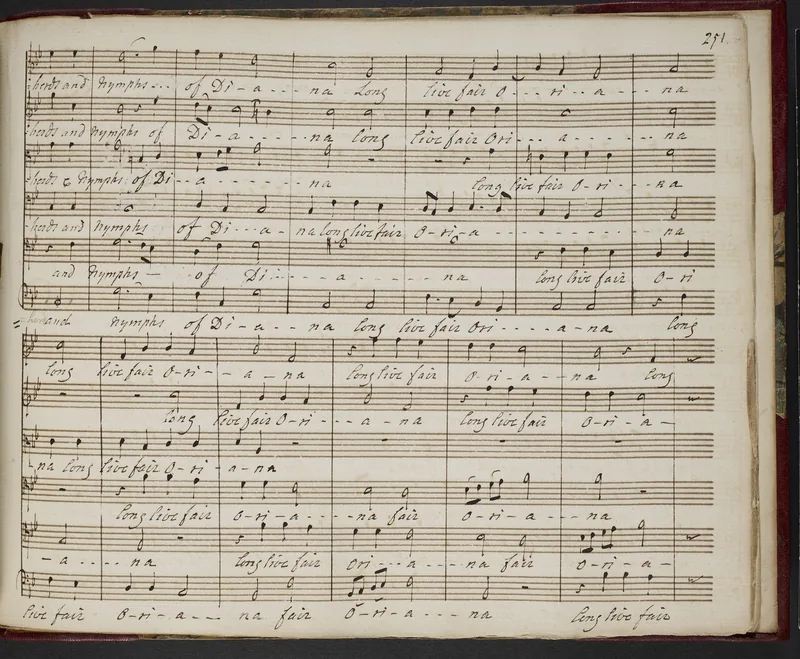
English composers took up the Italian style after the 1588 anthology. The British Library holds a manuscript copy of John Wilbye’s madrigal The Lady Oriana, in the hand of Thomas Edmund Warren. Its refrain, Long live fair Oriana, spreads the syllables of Diana over a run of notes, a device called melisma, so that one name is sung to many pitches.
Thomas Campion, writing in the preface to his first book of lute songs in 1601, called the close observing of words in music childish and ridiculous.
Monteverdi and the words as master
The quarrel that shaped the late madrigal is told in full in the rise of functional tonality. Giovanni Maria Artusi criticised Monteverdi’s unpublished madrigals in 1600. In 1603 a second part of Artusi’s book printed the term seconda pratica, attributed to an anonymous defender of Monteverdi. Monteverdi adopted the term in the preface to his Fifth Book of Madrigals (1605), where he set out a second practice in which the words, rather than the rules of harmony, govern the music.
That position gives word painting a theoretical footing. If the text rules the harmony, a single word may change the chord, the rhythm or the register of the line that carries it.
Monteverdi’s madrigals fill nine books. They carry the form from the polyphony of the late sixteenth century toward solo song with continuo and the concertato style. His Eighth Book, published in 1638, contains the Combattimento di Tancredi e Clorinda, which uses the stile concitato, an agitated style that employs string tremolo.
Word painting after the madrigal
The device outlived the madrigal. In Handel’s Messiah, the setting of “every valley shall be exalted” from Isaiah 40:4 puts the word valley on a low note and gives exalted a rising figure. The final word, plain, is held over a series of long notes. Popular music has the same habit: in Garth Brooks’s “Friends in Low Places”, the word low is sung on a low note.
Listening for word painting
Start with the text, not the music. Work through a passage in four steps:
- Find the word and read its meaning in the translation.
- Note the pitch under the word and the pitches on either side of it.
- Ask whether that note is higher, lower, longer or more chromatic than its neighbours.
- Sing or play the shape, then compare it with the next word.
The two short examples below illustrate the kind of shape composers used. They are not quotations from any madrigal.
Use the ear training studio to practise the intervals you hear, and the virtual piano to test a melody against its text. The polyphony entry explains how several independent voices sing at once, which is the texture of the madrigal.
Questions
What is word painting in music?
Word painting, also called text painting, is the technique of setting a word so that the music reflects its meaning, for example a falling line on a word about death or a rest on a word about silence. It was developed especially by late sixteenth-century Italian and English madrigal composers.
What is a madrigal in Renaissance music?
A madrigal is an unaccompanied secular vocal piece, usually for three to six voices, most typical of the Renaissance and early Baroque periods. It is usually through-composed, so each stanza receives different music that follows the emotion of its lines.
What were madrigalisms?
Madrigalisms was the name given to the word-painting devices of the late sixteenth-century madrigal. Critics such as Thomas Campion, writing in 1601, objected that the literal setting of single words was childish.
Who was Carlo Gesualdo?
Carlo Gesualdo, born in 1566, was an Italian nobleman and composer whose madrigals are known for extreme chromaticism. Few madrigalists followed that style, and Monteverdi chose to avoid its extremes.
What does seconda pratica mean?
Seconda pratica is Italian for second practice. The term first appeared in 1603 in a second part of Giovanni Artusi's book, where an anonymous defender of Monteverdi used it. Monteverdi adopted it in the 1605 preface to his Fifth Book of Madrigals, where the words govern the harmony.