String Tension in Drop Tunings: Pitch and Scale Length
Estimate how retuning and scale length change the same string’s tension, with a Drop D example and clear limits on gauge, feel and instrument safety.
On this page
Lowering a string by a whole tone changes its tension more than the pitch percentage alone suggests. In the ideal flexible-string model, tension is proportional to frequency squared. Scale length enters the same square-law relationship.
The String Tension Comparison uses that relationship without inventing a gauge database. It compares the same string specification under two conditions. A known manufacturer reference can turn the ratio into an estimated force; without one, the ratio is still useful.
Keep the string itself fixed
An ideal string’s fundamental frequency is:
f = √(T/μ) / (2L)
T is tension, L is vibrating length and μ is mass per unit length. Rearranging gives T = μ(2Lf)². UNSW’s string-vibration explanation describes the relationship between length, linear density, tension and frequency.
To compare two states of a string with the same μ, divide the second tension by the first:
T₂/T₁ = (L₂/L₁)² × (f₂/f₁)²
The unknown linear density cancels. That is why you can estimate the proportional effect of retuning without knowing the gauge. It is also why the same calculation cannot compare an unspecified old string with an unspecified heavier replacement: their densities no longer cancel.
Use the same length unit in both fields. A ratio of 25.5 inches to 24.75 inches works directly; a ratio mixing inches and millimetres does not. If you calculate an absolute tension from the full equation, all units must instead form a consistent physical system.
Work through low E to Drop D
Use sounding pitches. At A4 = 440 Hz in twelve-tone equal temperament, the guitar’s low open E is E2, about 82.4069 Hz. D2 is about 73.4162 Hz. The frequency ratio is 2^(−2/12), approximately 0.890899.
Square that ratio while keeping the scale length fixed. The tension ratio is about 0.793701. The string retains 79.3701% of its original tension, so its tension falls by 20.6299%. Those percentages describe different things: remaining tension and change from the original.
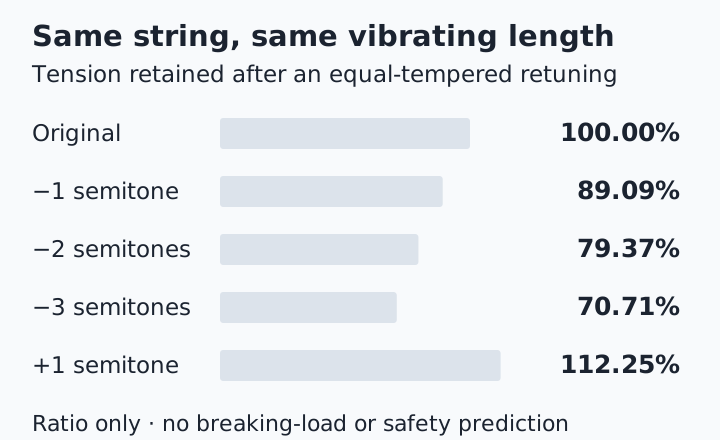
| Retuning from the reference pitch | Tension retained | Change |
|---|---|---|
| One semitone down | 89.09% | −10.91% |
| Two semitones down | 79.37% | −20.63% |
| Three semitones down | 70.71% | −29.29% |
| One semitone up | 112.25% | +12.25% |
These are ideal-model calculations. They are not permissions to raise a string’s tuning or predictions of its breaking point. A large percentage change deserves attention even when the musical interval sounds small.
Add a reference force only when it matches
Suppose a manufacturer specifies 20 lbf for a particular string at the original pitch and scale length. This is an illustrative reference, not a claim about a particular product. Multiplying by 0.793701 gives an estimated 15.874 lbf after the E2-to-D2 change.
A tension figure from a different scale length is not yet the right reference. Neither is a value for another string with a similar printed gauge. Copy the reference conditions together: product, pitch, vibrating length and force unit. D’Addario’s specifications guidance explains where its product tension charts can be found.
Pounds-force is a force unit; pounds of string mass is a different quantity. Newtons are also force units. The comparison tool keeps the unit supplied with the reference and does not silently convert an entered number when you change its label.
Compare scale lengths at the same pitch
For an identical string specification tuned to the same pitch, moving from a 25.5-inch vibrating length to 24.75 inches gives a tension ratio of (24.75 / 25.5)², about 0.942042. The shorter scale requires about 94.20% of the original ideal tension, a decrease of 5.80%.
If the shorter-scale instrument is also tuned down from E2 to D2, multiply the two effects. Using unrounded ratios gives about 0.747699, or 74.77% of the original tension. Adding the two percentage decreases would give a different and incorrect answer.
Use the open vibrating scale length for this comparison, rather than the total length of wire from tuner to ball end. On a multiscale instrument, use the relevant string’s length. Saddle compensation and the actual endpoints can introduce small differences from the nominal scale written in a specification.
Distinguish a capo from a retuning
A capo changes the vibrating endpoint. In the simplest model, shortening a string while leaving its tension unchanged raises frequency inversely with length. L becomes smaller while f becomes larger, so their product remains constant. The tension equation is consistent with that result.
Retuning the open string is a different operation: L stays nearly fixed while tension changes. Entering the capo-to-saddle distance as a new open scale length, then keeping the original pitch in the calculator, describes a hypothetical retuned string rather than the action of putting on the capo.
Real capos and fretting can also stretch strings slightly. Pressure, action height and contact geometry can affect intonation. Use the capo guide for the musical transposition and the fretboard to check sounding notes. Neither tool determines the structural load an instrument can tolerate.
Check the octave before interpreting a big result
Guitar notation commonly writes pitches an octave above their sound. The low E usually written as E3 sounds E2. Entering E3 as the reference while using D2 as the destination creates an unintended octave difference in addition to the whole tone.
Doubling frequency multiplies this model’s tension by four. An implausibly large change can therefore begin with an octave-entry mistake. The scientific pitch notation guide and frequency table make that check straightforward. B♯3 and C4 are equal in this tuning system, but E2 and E3 are not interchangeable.
Leave setup decisions to the actual instrument
The model does not include stiffness, changes in linear density as the string stretches, saddle friction, wear or breaking strength. It does not predict action, buzzing, bend resistance, intonation or neck movement. Tension is one physical quantity among several that affect feel.
When changing gauges, materials or instrument type, use the manufacturer’s string-specific data and appropriate setup guidance. If a change raises questions about a bridge, neck or unusual tuning, consult a qualified technician. Save the comparison’s inputs and assumptions as a note for that discussion rather than treating a calculated force as a safety rating.
Questions
How much tension does the low E string lose in Drop D?
At unchanged scale length and linear mass density, lowering E2 to D2 gives about 79.37% of the original tension, a reduction of about 20.63%. This ideal-model ratio does not establish whether a particular setup is suitable.
Can gauge alone tell me a wound string’s tension?
No. A wound string’s core, winding and materials affect its mass per unit length. Two strings with the same outside diameter can have different tension at the same pitch and length.