Calculate Loop BPM from Bars and Seconds, Even in 6/8
Work out a loop’s BPM from its trimmed duration, choose the right beat unit and calculate tempo-change ratios without confusing speed with stretch.
On this page
A loop’s duration gives an exact tempo calculation only after you decide how many complete bars it contains and which note value counts as a beat. The arithmetic cannot detect a pickup, an extra half bar or a ringing cymbal tail.
Use the Loop Tempo Calculator once you have trimmed the boundaries. It reports the chosen beat-unit BPM, the equivalent quarter-note tempo and the settings needed to fit a target tempo. No audio file is uploaded or analysed.
Measure between equivalent downbeats
For a four-bar loop, measure from the downbeat of bar 1 to the downbeat of bar 5. The second boundary marks the end of the fourth bar. Stopping at the last attack in bar 4 leaves part of the bar out; including the full decay after bar 4 adds time that does not belong to the repeating grid.
Listen through several repetitions. If the loop has a pickup, decide where its first full bar begins. Preserve the pickup separately or describe its actual number of beats. Do not call an incomplete phrase four bars merely because the filename says “4bar.”
Take four bars of 4/4 lasting 8.000 seconds. There are sixteen quarter-note beats. Dividing sixteen by eight gives two beats per second; multiplying by sixty gives 120 BPM. The same recording described as two bars would return 60 BPM. Both calculations are internally consistent, but only your count determines which describes the intended meter.
Convert the time signature into note values
The top number counts the note values named by the bottom number. It does not always count the beats a musician feels. Six-eight contains six eighth notes per bar and is commonly grouped as two dotted-quarter beats.
The general calculation begins with quarter-note equivalents:
quarter notes = bars × numerator × 4 / denominator
Then divide by the selected beat’s length in quarter notes. An eighth note is 0.5 quarters, a quarter is 1 and a dotted quarter is 1.5. BPM is sixty times that beat count divided by duration in seconds.
| One bar | Quarter-note equivalents | Dotted-quarter equivalents |
|---|---|---|
| 4/4 | 4 | 2⅔ |
| 3/4 | 3 | 2 |
| 6/8 | 3 | 2 |
| 7/8 | 3.5 | 2⅓ |
The fractional entries are mathematical conversions, not advice to feel every meter in dotted quarters. In 7/8, a grouping such as 2+2+3 eighths has unequal group lengths. The time-signature guide explains what the printed numbers specify; the grouping still needs to be heard or marked.
Solve the 6/8 tempo mismatch
Four bars of 6/8 contain twenty-four eighths, twelve quarters or eight dotted quarters. If the loop lasts eight seconds, its tempo is 180 eighth-note BPM, 90 quarter-note BPM or 60 dotted-quarter BPM. The audio does not change when you change the label.
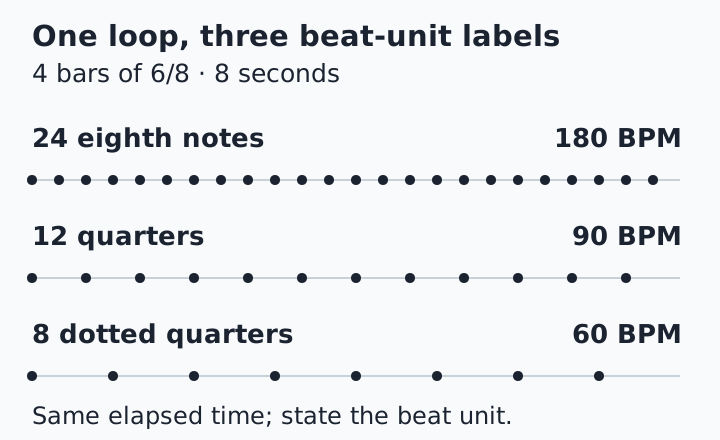
The 6/8 versus 3/4 article demonstrates why equal total duration does not imply equal accent patterns. When moving from a score to a DAW, convert the tempo unit rather than rewriting the music’s grouping to match a number.
For example, a score marked dotted quarter = 90 corresponds to quarter = 135. A four-bar 6/8 loop then lasts 8 × 60 / 90, or about 5.333333 seconds. Entering 90 into a quarter-based tempo field makes that grid slower than the score intends. Always save the beat unit beside the BPM.
Calculate the target duration first
Suppose the eight-second 4/4 loop at 120 quarter-note BPM must fit 100. The beat count stays sixteen. Its new duration is 16 × 60 / 100 = 9.6 seconds.
The speed ratio is target tempo divided by original tempo: 100 / 120 = 0.833333. That is 83.3333% playback speed. The duration ratio goes in the opposite direction: 120 / 100 = 1.2, or 120% of the original duration.
Software labels are not interchangeable. A control asking for speed needs the first ratio; a control asking for new length as a percentage of old length needs the second. A field asking for the percentage increase in length would instead need 20%. Check the editor’s definition and verify the resulting 9.6-second duration.
Choose between varispeed and pitch preservation
Varispeed couples time and pitch. Playing the loop at 0.833333 of its original speed lowers every frequency by that factor. In equal-tempered semitones, the change is 12 × log₂(0.833333), approximately −3.1564 semitones.
Pitch-preserving time stretch aims to alter duration while retaining pitch. Its artifacts depend on the source and algorithm. A drum transient, a sustained vowel and a dense full mix can need different treatment. The Ableton warping manual distinguishes Re-Pitch, which changes playback rate, from modes intended for other time-stretching tasks. Follow the equivalent documentation for your editor.
The calculator reports both the timing ratio and the varispeed pitch consequence. It does not apply either process. If you choose pitch preservation, do not also apply the displayed varispeed transposition unless that extra pitch change is intentional.
Investigate drift instead of rounding it away
A duration calculation returns an average tempo over the selected span. A live performance may accelerate in the middle and slow again before the end. Its boundaries can fit the grid while its internal attacks drift.
Check the first downbeat, an internal bar boundary and the loop end. If the internal boundary misses while the ends match, one global ratio is insufficient. Local timing markers may be needed. If every repeated loop falls progressively behind, inspect the trim and the stated bar count before adding markers.
At 48 kHz, one sample frame lasts about 20.833 microseconds. A 9.6-second target is exactly 460,800 frames. Other calculated durations may fall between frames and require rounding in the editor. Keep enough precision for the loop length, then listen for the seam; a mathematically correct boundary can still click if the waveform jumps.
Use Tap Tempo to check whether the calculated pulse feels plausible and the metronome to rehearse against it. Save the original duration, bar count, meter and unit with the exported ratio. A bare “100 BPM” loses the information needed to repeat the calculation.
Questions
How do I calculate BPM from a four-bar loop?
Count the beats in those bars, multiply by 60 and divide by the trimmed duration in seconds. Four bars of 4/4 contain sixteen quarter-note beats, so an eight-second loop is 120 quarter-note BPM.
Is a 6/8 tempo normally quarter-note BPM?
The musical pulse is often a dotted quarter, while a DAW tempo field commonly counts quarters. State the unit. Ninety dotted-quarter BPM and 135 quarter-note BPM describe the same elapsed time.